

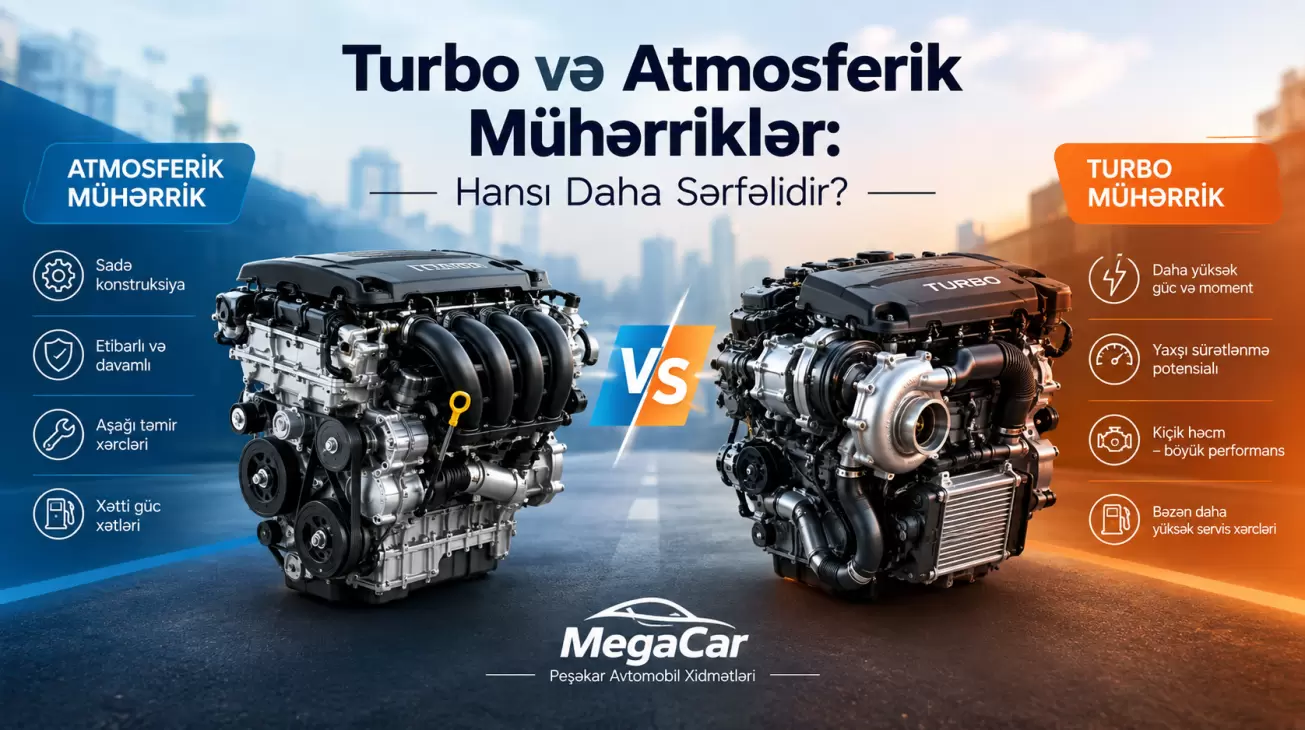
When choosing a car, the type of engine directly affects performance, fuel consumption, and maintenance costs. The two most common engine types are naturally aspirated and turbocharged engines.
But what is the main difference between these engines, and which option may be more suitable for you?
What Is a Naturally Aspirated Engine?
Naturally aspirated engines draw air into the cylinders without using additional forced-induction systems such as a turbocharger or supercharger. One of their main advantages is their relatively simple construction.
Main advantages:
- Simpler construction
- Relatively easy maintenance and repair
- More predictable and linear throttle response
- No additional turbo system components
These features can make naturally aspirated engines a practical choice for daily city driving and a calm driving style.
What Is a Turbocharged Engine?
Turbocharged engines use a turbocharger to deliver more air into the engine. A greater amount of air, together with the appropriate amount of fuel, allows the engine to produce higher power and torque.
For example, a relatively small-displacement turbocharged engine can provide power and torque comparable to those of a larger-displacement naturally aspirated engine.
Main advantages:
- Higher power and torque
- Greater acceleration potential
- The ability to achieve higher performance from a smaller-displacement engine
- High torque, especially at low and medium engine speeds
However, the additional components of a turbo system make the engine more complex and, in some cases, may increase maintenance costs.
Which Engine Is Easier to Maintain?
Naturally aspirated engines do not have a turbocharger, intercooler, or related additional systems, so their construction is generally simpler. This can make certain repair and maintenance tasks easier.
Turbocharged engines include components and systems such as a turbocharger, intercooler, and additional lubrication and cooling components. Therefore, it is particularly important to use the correct engine oil, change the oil on time, and follow the manufacturer's recommended service intervals.
Which Engine Is More Fuel-Efficient?
There is no single answer. Fuel consumption does not depend solely on whether an engine is turbocharged or naturally aspirated. The vehicle's weight, engine displacement, transmission, driving style, road conditions, and engine management system also play an important role.
A small-displacement turbocharged engine can provide good fuel economy when driven calmly and efficiently. However, under high load and aggressive driving conditions, the fuel consumption of a turbocharged engine can increase significantly.
Which One Should You Choose?
If simple construction, convenient daily use, and easier maintenance are important to you, a naturally aspirated engine may be a suitable choice.
If higher power, faster acceleration, and dynamic driving are important to you, a turbocharged engine may be a more suitable option.
Most importantly, do not focus only on the engine type. Pay attention to the specific engine model, service history, technical condition, and manufacturer's requirements of the vehicle.
MegaCar provides professional maintenance services for both turbocharged and naturally aspirated engines, helping ensure that your vehicle receives proper and timely maintenance.