



When a driver sets out on a long journey, the same questions usually come to mind: Is the fuel tank full? Is the car in good condition? Is the navigation turned on? And when will I arrive?
But a long-distance journey is very different from driving within a city.
Especially on unfamiliar roads, the situation can change within just a few minutes. A road that seems clear and easy to see during the day can look completely different at night. A sudden depression in the road surface, a road sign that is not clearly visible, a changed traffic direction due to roadworks, an unlit section, or a dangerous manoeuvre by an oncoming driver can put you in a situation you did not expect.
Sometimes, however, the greatest danger comes not from the road itself, but from the behaviour of another driver.
Therefore, the main principle of safe driving on a long journey is not simply being good at controlling the vehicle.
The key is to be prepared for unexpected situations.
The first question before setting off: “Am I ready for this road?”
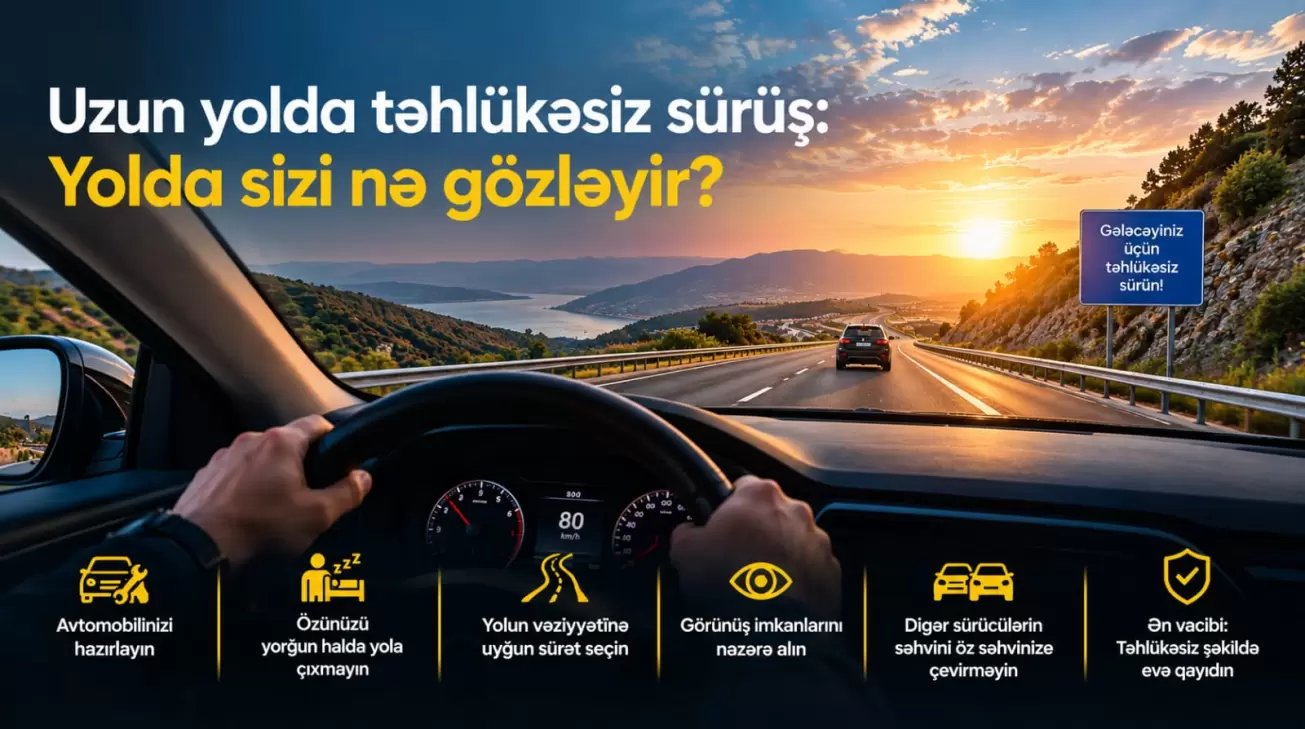
Before starting a long journey, it is important to check the vehicle. Basic points such as the condition of the tyres, braking system, lights, engine oil, coolant and windscreen wipers should be checked.
But the driver must be prepared just as much as the vehicle.
Driving when sleep-deprived, very tired or irritated can reduce a driver's reaction time. Ignoring fatigue with the thought “I’ll stop a little later” can be particularly risky during long journeys.
Feeling fine at the beginning of a journey does not mean you will feel the same way several hours later.
A road you know during the day can be completely different at night
You may have driven along the same road many times during the day. The road feels familiar.
But at night, the situation changes.
The edges of the road become less visible, some obstacles are noticed later, and the headlights of oncoming vehicles can affect visibility. On an unfamiliar road, another problem appears:
You do not know what you will encounter just a few metres ahead.
For this reason, when driving at night on an unfamiliar road, your speed should be chosen so that you have enough distance to react safely when you notice an obstacle.
A road looking empty does not mean that increasing your speed makes it safer.
The road surface can catch you off guard
On some roads, drivers may encounter depressions, potholes and other forms of road-surface deformation.
During the day, a driver may be able to notice such an obstacle in advance.
At night, the situation becomes more difficult.
Especially after rain, it can be difficult to determine the depth and shape of a pothole. Sometimes it is impossible to assess the condition of a section of road if it is covered with water.
In such a situation:
-
do not blindly follow the movement of the vehicle ahead;
-
adjust your speed to the road conditions;
-
avoid sudden steering movements;
-
maintain sufficient visibility ahead and a safe following distance.
Most importantly:
Do not drive on an unfamiliar road with the assumption that “there is nothing here”.
If a road sign is not visible, the risk increases
On a long journey, road signs do more than show directions. They provide advance information about the road conditions ahead.
However, in some areas you may encounter situations where signs are not clearly visible, roadworks are not properly marked, or the driver is warned too late.
In such situations, the driver should be more cautious because they do not know what is ahead.
Especially at night:
an invisible sign = a possible invisible risk.
Therefore, on an unfamiliar road, it is safer to choose your speed not only according to how empty the road is, but also according to how far ahead you can clearly see.
When another driver makes you angry...
One of the most difficult challenges on a long journey is sometimes not the car, but another driver.
For example:
The vehicle ahead of you continues driving unnecessarily slowly for a long time.
The driver behind you gets too close instead of keeping a safe distance and flashes their headlights.
Another driver makes a dangerous overtaking manoeuvre.
Another vehicle suddenly moves into your path.
Such situations can make a driver angry.
And that is exactly when a very dangerous change can occur:
The driver stops thinking about the road and starts thinking about “punishing” the other driver.
They increase their speed.
They make an unnecessary overtaking manoeuvre.
They reduce the distance.
The thought appears: “I’ll show him now.”
But the road itself has not changed.
The driver's decision has changed.
Do not follow a driver who pressures you to drive faster
Sometimes the speed of a vehicle approaching from behind can make you increase your own speed.
It is as if the other driver is telling you: “Increase your speed too.”
But the speed they have chosen may not be safe for you.
They may know the road well.
Their vehicle may be different.
They may see a danger ahead.
Or they may simply be driving in violation of the rules.
Another driver's hurry should not determine your decision.
On a long journey, a good driver responds to the condition of the road, not to the speed of another vehicle.
If you are travelling on an unfamiliar road for the first time...
If you are travelling on a road for the first time, give yourself some extra time.
Navigation is useful for showing the direction, but it cannot see every pothole for you, assess the condition of the road surface or predict what another driver will do.
If you do not know the road:
-
approach bends more cautiously;
-
maintain enough distance to see obstacles in advance;
-
make overtaking decisions without rushing;
-
do not hesitate to reduce your speed if you are unsure about the condition of the road.
On an unfamiliar road, being a few minutes late is better than losing a few seconds in an unexpected situation.
A long journey during the day or at night?
Both situations have their own challenges.
Long journey during the day
Although visibility is better, driving continuously for a long time can cause fatigue.
Sunlight directly ahead can also reduce visibility. On the other hand, there may be more vehicles on the road.
Long journey at night
Visibility distance is reduced.
The headlights of oncoming vehicles can cause glare.
Pedestrians, animals and obstacles on the roadside can be harder to see.
On an unfamiliar road, there is also the additional problem of not knowing the road layout.
Therefore, when driving a long distance at night, instead of increasing your speed because “the road is empty”, you should consider your visibility and ability to react in time.
And there is one more dangerous moment: “I’m almost there”
Towards the end of a long journey, drivers sometimes begin to feel more relaxed.
“Only a little left.”
“I’ll be there soon.”
“This is the final section.”
But fatigue can still reduce attention at this stage.
After driving for several hours, a driver may no longer have the same level of concentration they had at the beginning of the journey.
Therefore, taking a break during a long journey should not be considered something necessary only when you are already tired.
Sometimes a short break can help the driver regain focus.
What does a good long-distance driver do?
A good driver is not the fastest driver.
A good driver:
Reads the road.
Tries to anticipate the situation ahead.
Is more cautious on unfamiliar roads.
Takes visibility conditions at night into account.
Chooses a speed appropriate to the road conditions.
Does not turn another driver's mistake into their own mistake.
Does not make a risky manoeuvre simply to respond to a driver who has irritated them.
And most importantly, considers getting home safely more important than proving something on the road.
Ask yourself this question before setting out on a long journey
“Is it more important for me to get there as quickly as possible, or to return home safely?”
Because you can never know exactly what awaits you on a long road.
The road surface may be damaged.
A sign may not be visible.
An unexpected obstacle may appear ahead.
It may start raining.
You may encounter an unfamiliar bend.
Another driver may make a mistake.
Or you may simply become tired after several hours of driving.
Good driving is not believing that none of these things will happen.
Good driving is travelling while taking into account that any of these things may happen.
And perhaps the most important rule of a long journey is this:
The road may rush you. Another driver may rush you. You may even rush yourself.
But the decision is still yours.
Let the road conditions determine your speed, not your emotions and your hurry.